A school jury in 3D animation or special effects is not looking to discover a seasoned artist. They seek a candidate capable of functioning within a production pipeline, accepting feedback, and redoing a scene without losing focus. This distinction radically changes how one builds their admission portfolio.
Think of your portfolio as a studio deliverable, not a personal gallery
Many candidates gather their best drawings, a few models created in Blender, and a demo reel set to epic music. The result then resembles an independent artist’s portfolio, while the jury expects a profile of a future junior studio artist.
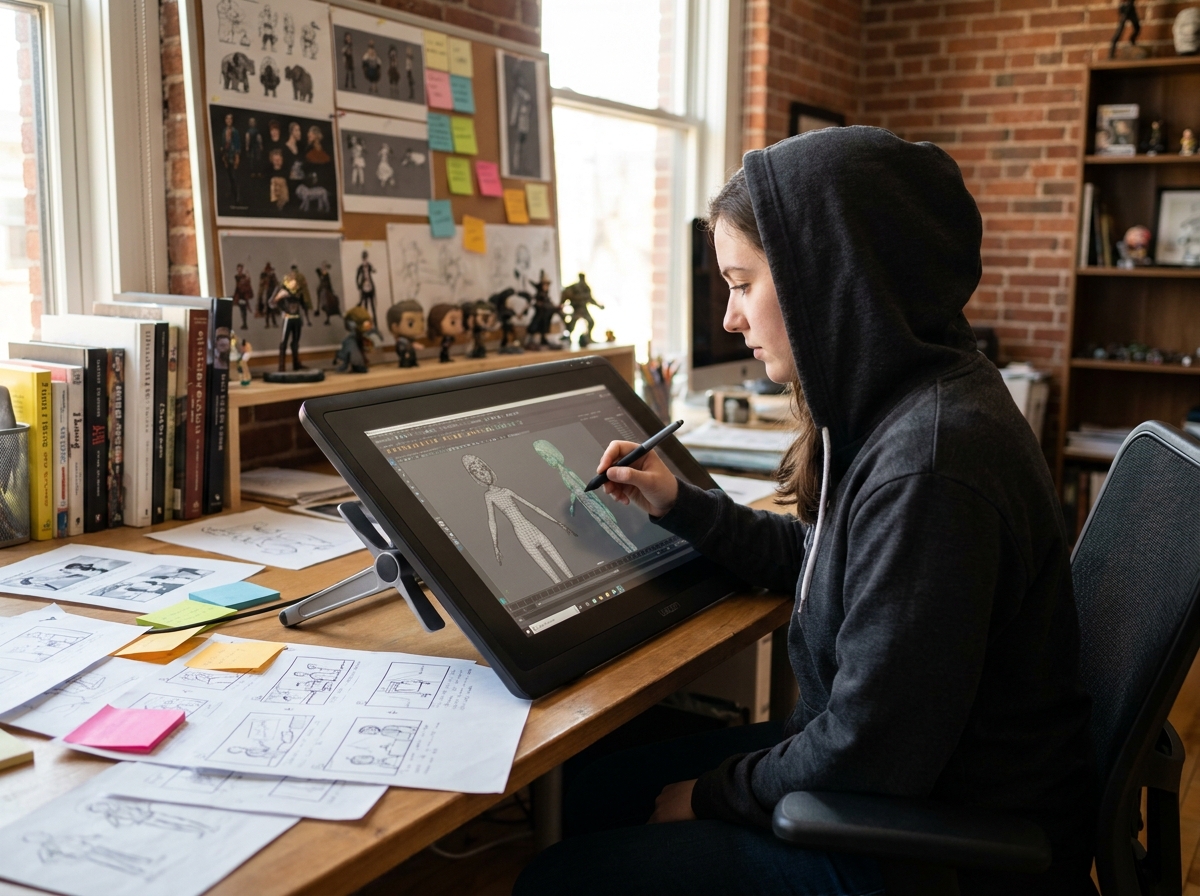
What makes the difference is showing that you have already integrated production constraints into your work. Specifically, this means presenting a project with an initial brief (even self-imposed), documented intermediate steps, and a final result that meets this brief. You demonstrate that you know how to prepare an admission portfolio in 3D animation by structuring each piece as a response to a problem, not as a free demonstration.
Documenting your iterations is as important as the final render. A 3D model presented with three successive versions (blocking volumes, adjusting proportions, textured version) tells a story of work that the jury can read. An isolated render, no matter how beautiful, says nothing about the method.
Production constraints to integrate into the 3D animation portfolio

Specialized schools in VFX and animation increasingly evaluate the candidate’s maturity in relation to the realities of the profession. We are not talking about advanced technical mastery, but a production-oriented mindset.
Here are the concrete elements that transform a generic portfolio into a solid application:
- A project completed with an explicit time constraint (for example, a character modeled in one week with a dated log) proves that you can work under a deadline.
- Visual references cited and visible in the portfolio (concept art from films, mood boards drawn from existing productions) show that you anchor your work in the industry, not in a vacuum.
- At least one collaborative project, even informal (a short film made with friends, a game jam), where you specify your exact role and the adjustments made based on feedback from other members.
- A piece revised after critique, presented in a before/after version with a note explaining what was changed and why.
The jury looks for evidence of iteration, not perfection. A candidate who shows three versions of the same scene with reasoned corrections immediately stands out from one who piles up ten finished pieces without context.
Explain your use of generative AI in the creative process
Admission portfolios for 2025-2026 incorporate a new dimension. Schools are increasingly asking candidates to clarify their relationship with generative AI tools in their creative pipeline. Ignoring this topic in your portfolio leaves a doubt about the authenticity of your work.
The most effective approach is to name the tools used and specify at which stage they are involved. For example: “I used an image generator to explore color directions during the research phase, then I manually redrew the selected compositions.” Being transparent about AI enhances the candidate’s credibility rather than undermining it.
Juries penalize undeclared use or the final render that is entirely generated without manual intervention. The implicit rule: AI can inform the thinking process, but the technical gesture must remain identifiable.
Cover letter and interview: talk production, not passion

The typical cover letter (“since I was a child, I have been passionate about special effects”) no longer works. Juries read hundreds of variations of this phrase each year.
What captures attention is a candidate who talks about their work with operational vocabulary. Mention a specific software and what you learned by using it. Describe a technical blockage encountered on a personal project and the solution found. Use industry vocabulary rather than passion language.
For the interview, preparation involves three concrete axes:
- Know the curriculum of the targeted school, its specializations (compositing, rigging, character animation), and be able to explain why this orientation matches your profile.
- Be able to comment on each piece of your portfolio in under two minutes, explaining the brief, constraints, and technical choices.
- Anticipate the question about your professional project with answers grounded in the reality of the sector (type of studio targeted, position sought upon graduation) rather than vague phrases about “working in film.”
Feedback varies on this point, but several testimonials from former candidates converge: juries almost systematically ask a question about a failure or an abandoned project. Having prepared an honest answer focused on what you learned from it avoids awkward silence.
Selection criteria for 3D animation schools: what really matters
Beyond the portfolio and the interview, the choice of the school itself influences the construction of the application. The RECA label and the school’s professional network weigh in the evaluation of the candidate’s path by recruiters after graduation. A bachelor’s degree in 3D/VFX represents a significant financial investment, and candidates benefit from integrating this strategic dimension from the application stage.
Alternating work-study programs, offered from advanced levels in several curricula, constitute a strong argument. Mentioning in your letter that you aim for a program that includes studio immersion shows that you are already thinking in terms of professional integration.
A convincing admission portfolio in 3D animation relies on evidence of method, the ability to work under constraints, and a clear vision of what you seek from the training. Each piece of the portfolio, each sentence of the cover letter must answer a simple question: will this candidate be able to function in a team, within a real pipeline, from the first year?